English Español
0 $0.00
items in your cartto quote Checkout
Ooops no items were found.
Try something else.
Ok
Loading…

OSHA Temporary Stair Requirements: When Jobsite Stairs Are Needed

OSHA Temporary Stair Requirements: When Jobsite Stairs Are Needed

Temporary access is one of the most important parts of a safe and productive jobsite. Ladders may be useful for quick access, inspections, or short-duration tasks, but they are not always the best choice when crews need regular movement between levels.

When workers are accessing excavations, rooftops, equipment platforms, elevated work areas, or changing jobsite elevations throughout the day, temporary stair access may be a safer and more efficient solution.

At TPR Industrial, we supply SafeSmart modular stair systems for rental and purchase, helping contractors create safer access routes for construction, excavation, rooftop, industrial, and maintenance applications.

Do OSHA Standards Require Temporary Stairs?

OSHA requirements depend on the type of work, the access point, the elevation change, and how workers are using the area. There is not one simple rule that says every jobsite must use modular stairs instead of ladders.

However, OSHA does have stairway requirements for both construction and general industry settings. For construction, OSHA 1926.1052 covers stairways, including requirements for handrails, stairrails, treads, landings, and safe stairway use. For general industry, OSHA 1910.25 covers stairways used to provide access between walking-working surfaces.

The key point is this: when access becomes regular, routine, or heavily used, it is worth looking beyond a ladder and considering a stair system designed for repeated movement between levels.

When a Ladder May Not Be Enough

Ladders have their place. They are portable, easy to set up, and useful for certain short-term tasks. But problems can start when a ladder becomes the main access route for a crew.

A ladder may not be the best solution when:

  • Multiple workers use the same access point throughout the day
  • Crews are carrying tools, materials, or equipment
  • The access point is used for more than quick, occasional entry
  • Workers are moving between uneven or changing elevations
  • The site has mud, rain, debris, or unstable ground conditions
  • Access is needed for several days, weeks, or months
  • The ladder creates congestion or slows down production

In these situations, a temporary stair system can give workers a more stable and natural way to move between levels.

Regular Access Changes the Equation

One of the best ways to think about temporary stair access is frequency. If workers only need quick, occasional access, a ladder may be appropriate. But if crews are using the same access route repeatedly, a stair system may be a better fit.

OSHA’s general industry stairway standard references standard stairs for operations that require regular and routine travel between levels. That same concept applies to many active jobsites: the more often workers use an access point, the more important that access point becomes.

Temporary stairs can help improve footing, reduce congestion, and make it easier for workers to move safely and efficiently throughout the day.

Common Jobsites That May Need Temporary Stair Access

Temporary stair systems are used across many construction and industrial applications. They are especially useful where access changes over time or where crews need a dependable route between elevations.

Common applications include:

  • Excavation access
  • Rooftop access
  • Temporary building access
  • Access over obstacles
  • Industrial maintenance
  • Shutdown work
  • Equipment platform access
  • Multi-level construction projects
  • Long-term jobsite access routes

For many of these applications, modular stairs can provide a safer and more efficient alternative to ladders, job-built stairs, or makeshift access points.

Why Modular Stair Systems Improve Jobsite Access

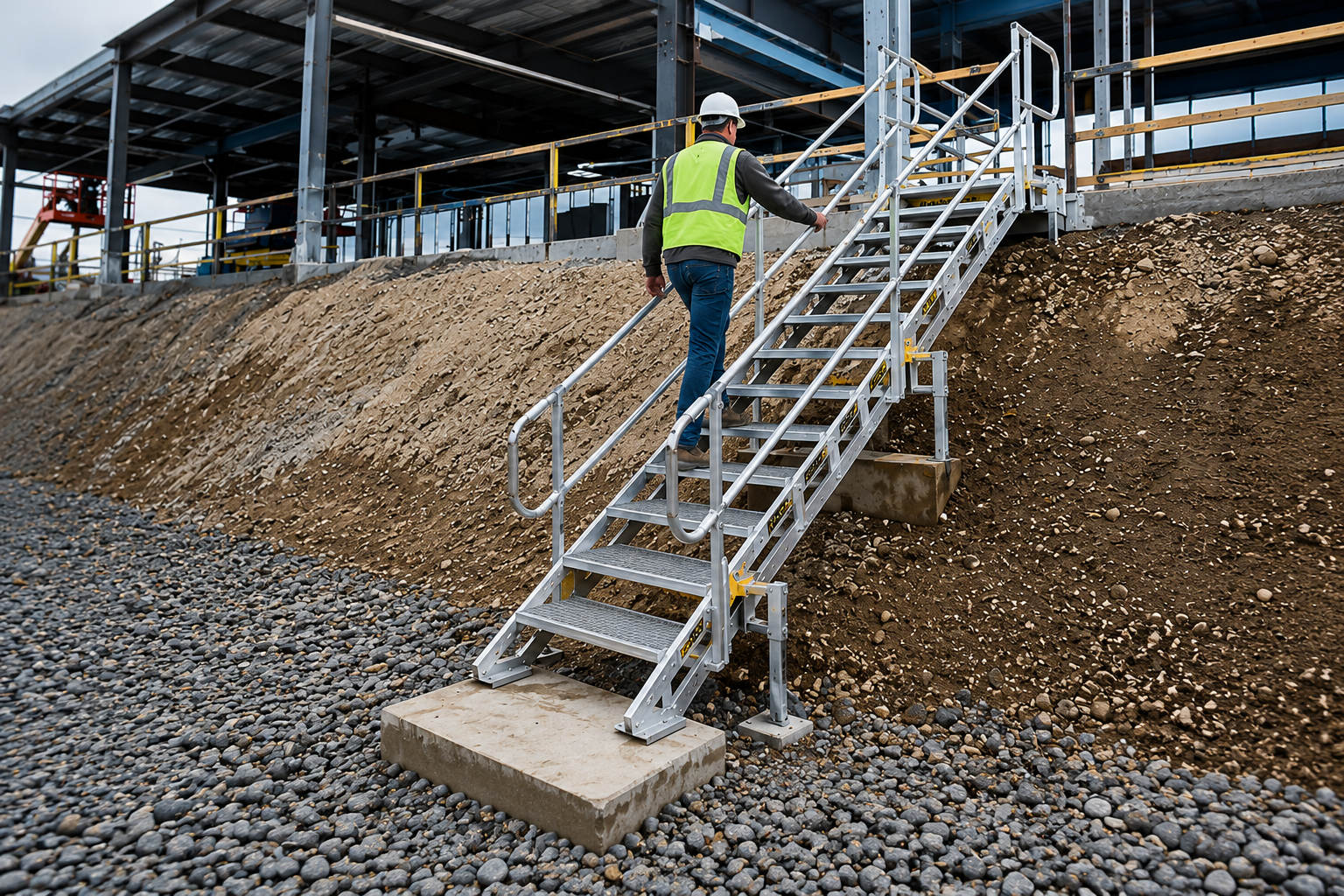
A modular stair system gives workers a more controlled way to move between levels. Instead of climbing vertically on a ladder, crews can walk up and down using stair treads and handrail support.

This can help improve both safety and productivity on active jobsites.

Modular stair systems can help:

  • Improve worker movement between levels
  • Reduce congestion at busy access points
  • Provide more stable footing than ladder access
  • Make it easier to carry tools and small equipment
  • Support changing jobsite conditions
  • Reduce the need for job-built temporary stairs
  • Create reusable access solutions for future projects

Better access does more than support safety. It can also help keep crews moving and reduce delays caused by poor jobsite flow.

Rental vs Purchase: Which Makes Sense?

One advantage of modular stair systems is flexibility. Contractors can rent or purchase depending on the project timeline, access needs, and expected future use.

Rental may make sense when:

  • The project is short-term
  • Access is only needed for a defined phase
  • The jobsite layout may change
  • The contractor wants to avoid owning extra equipment
  • The system is needed for excavation, rooftop, or temporary project access

Purchase may make sense when:

  • The contractor regularly needs temporary access
  • The stair system can move from job to job
  • Access needs are predictable
  • The company wants a reusable solution
  • Long-term projects require dependable stair access

TPR Industrial can help review the access height, jobsite conditions, project timeline, and expected crew traffic to determine whether rental or purchase is the better fit.

SafeSmart Stair Options from TPR Industrial

Not every jobsite needs the same temporary stair setup. The right system depends on height, access angle, ground conditions, project duration, and how workers will use the access point.

TPR Industrial offers several SafeSmart stair and access solutions, including:

AdjustaStairs™

AdjustaStairs™ are designed for temporary jobsite stair access where elevations may change. They are a practical option for construction access, excavation access, and jobsites where crews need a safer alternative to ladders or makeshift stairs.

High-Access AdjustaStairs™

High-Access AdjustaStairs™ are designed for larger elevation changes where additional reach is needed. They are a strong option for taller temporary access applications on construction and industrial jobsites.

H-Brace Stability Enhancement

The H-Brace Stability Enhancement helps improve stability on AdjustaStairs systems. It is a useful accessory when additional support is needed for wider or higher access setups.

AdaptaStep™ 45° Crossover System

The AdaptaStep™ 45° Crossover System is designed for crossover access, rooftop transitions, parapet walls, elevation changes, and obstacles where ladders or makeshift access may fall short.

Use the AdjustaStairs Size Chart to Plan Access Height

Before selecting a temporary stair system, it helps to understand the access height needed for the jobsite. TPR Industrial provides an AdjustaStairs™ Size Chart to help contractors review available stair sizes and access height ranges.

This chart can be a helpful starting point when planning temporary stair access for excavations, elevated work areas, rooftop access, or changing jobsite elevations.

How to Choose the Right Temporary Stair System

Before choosing a stair system, it helps to answer a few basic questions:

  • What height does the system need to reach?
  • How often will workers use it?
  • Will crews be carrying tools or materials?
  • Is the access point temporary or long-term?
  • Is the ground level, uneven, muddy, or changing?
  • Does the project need rental or purchase?
  • Are handrails, guardrails, or added stability accessories needed?

These details help determine the right SafeSmart setup for the job.

Temporary Stair Access Helps Keep the Job Moving

Temporary access is easy to overlook until it becomes a problem. A poor access point can slow crews down, create congestion, and increase the chance of slips, trips, or falls.

A modular stair system helps solve that problem by giving workers a stable, repeatable access route that can adapt to changing jobsite conditions. For contractors managing active projects, that can mean better movement, fewer delays, and a safer setup from the start.

When a ladder is not enough, temporary stair access may be the better solution.

Need SafeSmart Stairs for an Upcoming Project?

TPR Industrial supplies SafeSmart modular stair systems for both rental and purchase. Whether you need short-term access for a project phase or a long-term stair system for ongoing work, our team can help configure the right solution.

Call TPR Industrial today at (503) 353-7676 or Request a Quote.

FAQ: OSHA Temporary Stair Requirements

Are temporary stairs required on construction jobsites?

It depends on the jobsite, access point, elevation change, and how workers are using the area. OSHA has stairway standards for construction and general industry, but each site should be reviewed based on the work being performed and how often workers need access between levels.

Are modular stair systems better than ladders?

For quick or occasional access, ladders may be appropriate. For repeated daily access, changing elevations, excavation access, rooftop access, or areas where workers carry tools, modular stair systems are often a safer and more efficient option.

Can modular stair systems be rented?

Yes. TPR Industrial offers SafeSmart modular stair systems for both rental and purchase, including short-term rental options and long-term project support.

What jobs use temporary stair systems?

Temporary stair systems are commonly used for excavation access, rooftop access, construction access, equipment platforms, industrial maintenance, shutdown work, and projects with changing elevations.

What is the difference between AdjustaStairs™ and High-Access AdjustaStairs™?

AdjustaStairs™ are used for temporary stair access and changing elevations. High-Access AdjustaStairs™ are designed for larger access heights where additional reach is needed.

How do I know what size AdjustaStairs system I need?

The best starting point is the access height needed for the jobsite. You can use the AdjustaStairs™ Size Chart to review stair size options and access height ranges before requesting a quote.

Can modular stairs replace job-built stairs?

In many situations, yes. Modular stairs can reduce setup time, provide a reusable access solution, and give crews a more consistent route compared with building temporary stairs from scratch.

Note: OSHA requirements can vary based on the jobsite and work being performed. This article is for general information only and should not replace a site-specific safety review.

OSHA Temporary Stair Requirements: When Jobsite Stairs Are Needed

OSHA Temporary Stair Requirements: When Jobsite Stairs Are Needed

Temporary access is one of the most important parts of a safe and productive jobsite. Ladders may be useful for quick access, inspections, or short-duration tasks, but they are not always the best choice when crews need regular movement between levels.

When workers are accessing excavations, rooftops, equipment platforms, elevated work areas, or changing jobsite elevations throughout the day, temporary stair access may be a safer and more efficient solution.

At TPR Industrial, we supply SafeSmart modular stair systems for rental and purchase, helping contractors create safer access routes for construction, excavation, rooftop, industrial, and maintenance applications.

Do OSHA Standards Require Temporary Stairs?

OSHA requirements depend on the type of work, the access point, the elevation change, and how workers are using the area. There is not one simple rule that says every jobsite must use modular stairs instead of ladders.

However, OSHA does have stairway requirements for both construction and general industry settings. For construction, OSHA 1926.1052 covers stairways, including requirements for handrails, stairrails, treads, landings, and safe stairway use. For general industry, OSHA 1910.25 covers stairways used to provide access between walking-working surfaces.

The key point is this: when access becomes regular, routine, or heavily used, it is worth looking beyond a ladder and considering a stair system designed for repeated movement between levels.

When a Ladder May Not Be Enough

Ladders have their place. They are portable, easy to set up, and useful for certain short-term tasks. But problems can start when a ladder becomes the main access route for a crew.

A ladder may not be the best solution when:

  • Multiple workers use the same access point throughout the day
  • Crews are carrying tools, materials, or equipment
  • The access point is used for more than quick, occasional entry
  • Workers are moving between uneven or changing elevations
  • The site has mud, rain, debris, or unstable ground conditions
  • Access is needed for several days, weeks, or months
  • The ladder creates congestion or slows down production

In these situations, a temporary stair system can give workers a more stable and natural way to move between levels.

Regular Access Changes the Equation

One of the best ways to think about temporary stair access is frequency. If workers only need quick, occasional access, a ladder may be appropriate. But if crews are using the same access route repeatedly, a stair system may be a better fit.

OSHA’s general industry stairway standard references standard stairs for operations that require regular and routine travel between levels. That same concept applies to many active jobsites: the more often workers use an access point, the more important that access point becomes.

Temporary stairs can help improve footing, reduce congestion, and make it easier for workers to move safely and efficiently throughout the day.

Common Jobsites That May Need Temporary Stair Access

Temporary stair systems are used across many construction and industrial applications. They are especially useful where access changes over time or where crews need a dependable route between elevations.

Common applications include:

  • Excavation access
  • Rooftop access
  • Temporary building access
  • Access over obstacles
  • Industrial maintenance
  • Shutdown work
  • Equipment platform access
  • Multi-level construction projects
  • Long-term jobsite access routes

For many of these applications, modular stairs can provide a safer and more efficient alternative to ladders, job-built stairs, or makeshift access points.

Why Modular Stair Systems Improve Jobsite Access

A modular stair system gives workers a more controlled way to move between levels. Instead of climbing vertically on a ladder, crews can walk up and down using stair treads and handrail support.

This can help improve both safety and productivity on active jobsites.

Modular stair systems can help:

  • Improve worker movement between levels
  • Reduce congestion at busy access points
  • Provide more stable footing than ladder access
  • Make it easier to carry tools and small equipment
  • Support changing jobsite conditions
  • Reduce the need for job-built temporary stairs
  • Create reusable access solutions for future projects

Better access does more than support safety. It can also help keep crews moving and reduce delays caused by poor jobsite flow.

Rental vs Purchase: Which Makes Sense?

One advantage of modular stair systems is flexibility. Contractors can rent or purchase depending on the project timeline, access needs, and expected future use.

Rental may make sense when:

  • The project is short-term
  • Access is only needed for a defined phase
  • The jobsite layout may change
  • The contractor wants to avoid owning extra equipment
  • The system is needed for excavation, rooftop, or temporary project access

Purchase may make sense when:

  • The contractor regularly needs temporary access
  • The stair system can move from job to job
  • Access needs are predictable
  • The company wants a reusable solution
  • Long-term projects require dependable stair access

TPR Industrial can help review the access height, jobsite conditions, project timeline, and expected crew traffic to determine whether rental or purchase is the better fit.

SafeSmart Stair Options from TPR Industrial

Not every jobsite needs the same temporary stair setup. The right system depends on height, access angle, ground conditions, project duration, and how workers will use the access point.

TPR Industrial offers several SafeSmart stair and access solutions, including:

AdjustaStairs™

AdjustaStairs™ are designed for temporary jobsite stair access where elevations may change. They are a practical option for construction access, excavation access, and jobsites where crews need a safer alternative to ladders or makeshift stairs.

High-Access AdjustaStairs™

High-Access AdjustaStairs™ are designed for larger elevation changes where additional reach is needed. They are a strong option for taller temporary access applications on construction and industrial jobsites.

H-Brace Stability Enhancement

The H-Brace Stability Enhancement helps improve stability on AdjustaStairs systems. It is a useful accessory when additional support is needed for wider or higher access setups.

AdaptaStep™ 45° Crossover System

The AdaptaStep™ 45° Crossover System is designed for crossover access, rooftop transitions, parapet walls, elevation changes, and obstacles where ladders or makeshift access may fall short.

Use the AdjustaStairs Size Chart to Plan Access Height

Before selecting a temporary stair system, it helps to understand the access height needed for the jobsite. TPR Industrial provides an AdjustaStairs™ Size Chart to help contractors review available stair sizes and access height ranges.

This chart can be a helpful starting point when planning temporary stair access for excavations, elevated work areas, rooftop access, or changing jobsite elevations.

How to Choose the Right Temporary Stair System

Before choosing a stair system, it helps to answer a few basic questions:

  • What height does the system need to reach?
  • How often will workers use it?
  • Will crews be carrying tools or materials?
  • Is the access point temporary or long-term?
  • Is the ground level, uneven, muddy, or changing?
  • Does the project need rental or purchase?
  • Are handrails, guardrails, or added stability accessories needed?

These details help determine the right SafeSmart setup for the job.

Temporary Stair Access Helps Keep the Job Moving

Temporary access is easy to overlook until it becomes a problem. A poor access point can slow crews down, create congestion, and increase the chance of slips, trips, or falls.

A modular stair system helps solve that problem by giving workers a stable, repeatable access route that can adapt to changing jobsite conditions. For contractors managing active projects, that can mean better movement, fewer delays, and a safer setup from the start.

When a ladder is not enough, temporary stair access may be the better solution.

Need SafeSmart Stairs for an Upcoming Project?

TPR Industrial supplies SafeSmart modular stair systems for both rental and purchase. Whether you need short-term access for a project phase or a long-term stair system for ongoing work, our team can help configure the right solution.

Call TPR Industrial today at (503) 353-7676 or Request a Quote.

FAQ: OSHA Temporary Stair Requirements

Are temporary stairs required on construction jobsites?

It depends on the jobsite, access point, elevation change, and how workers are using the area. OSHA has stairway standards for construction and general industry, but each site should be reviewed based on the work being performed and how often workers need access between levels.

Are modular stair systems better than ladders?

For quick or occasional access, ladders may be appropriate. For repeated daily access, changing elevations, excavation access, rooftop access, or areas where workers carry tools, modular stair systems are often a safer and more efficient option.

Can modular stair systems be rented?

Yes. TPR Industrial offers SafeSmart modular stair systems for both rental and purchase, including short-term rental options and long-term project support.

What jobs use temporary stair systems?

Temporary stair systems are commonly used for excavation access, rooftop access, construction access, equipment platforms, industrial maintenance, shutdown work, and projects with changing elevations.

What is the difference between AdjustaStairs™ and High-Access AdjustaStairs™?

AdjustaStairs™ are used for temporary stair access and changing elevations. High-Access AdjustaStairs™ are designed for larger access heights where additional reach is needed.

How do I know what size AdjustaStairs system I need?

The best starting point is the access height needed for the jobsite. You can use the AdjustaStairs™ Size Chart to review stair size options and access height ranges before requesting a quote.

Can modular stairs replace job-built stairs?

In many situations, yes. Modular stairs can reduce setup time, provide a reusable access solution, and give crews a more consistent route compared with building temporary stairs from scratch.

Note: OSHA requirements can vary based on the jobsite and work being performed. This article is for general information only and should not replace a site-specific safety review.

SEARCH ×