 English
 Español
Do You Need a Type 2 Safety Helmet? (And Why More Crews Are Upgrading)
If your crew is still using traditional hard hats, it’s worth asking a simple question:
Is top-impact protection enough for today’s jobsites?
For many companies, the answer is no.
Modern jobsite accidents don’t just involve objects falling straight down. Slips, trips, and falls often create angled impacts, which can generate rotational force—one of the leading contributors to serious head injuries.
That’s why more companies are moving to Type 2 safety helmets.
What Is a Type 2 Safety Helmet?
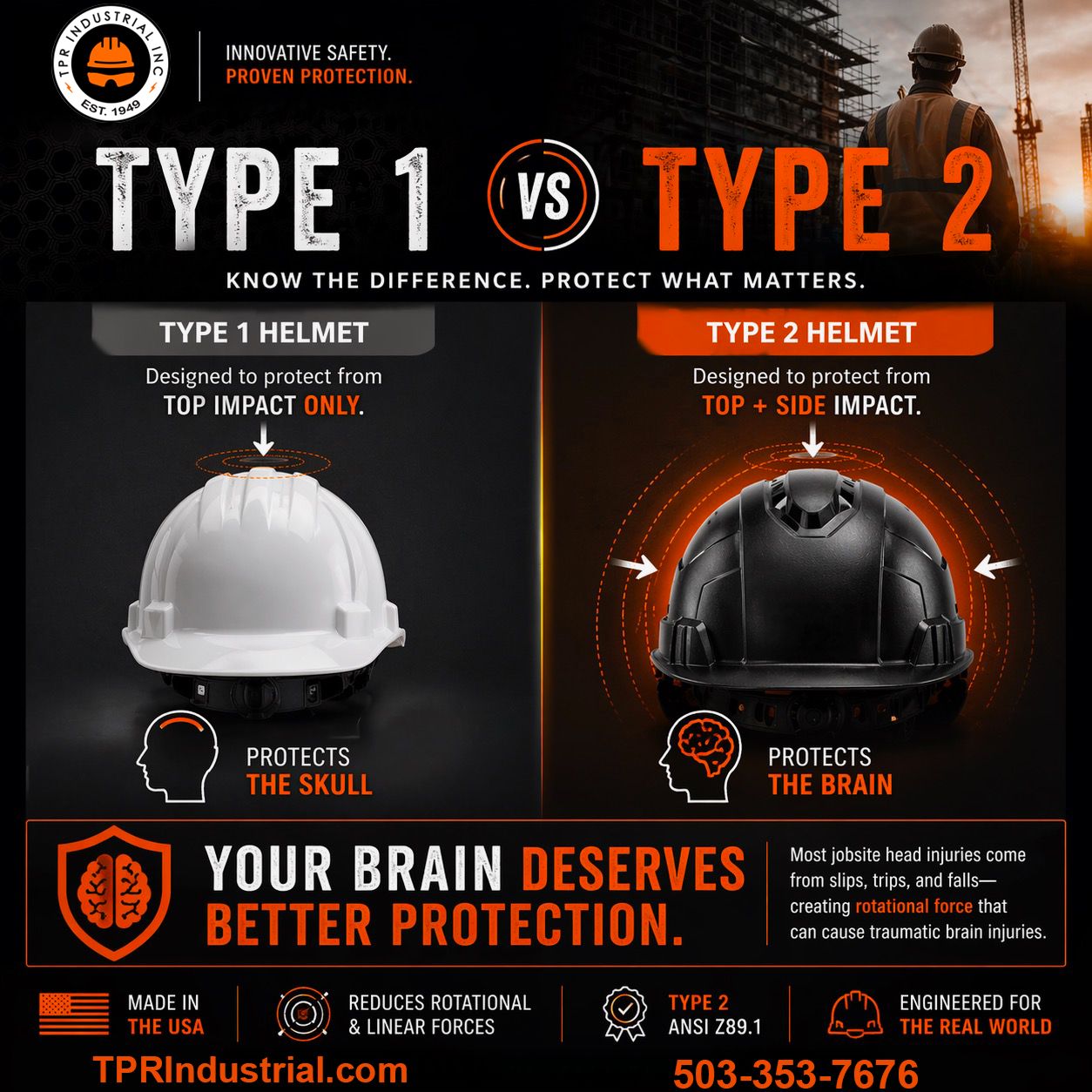
A Type 2 safety helmet is designed to protect from impacts to the:
- Top
- Front
- Back
- Sides
Traditional hard hats (Type 1) are primarily designed for top impact only.
Type 2 helmets provide a higher level of protection for real-world jobsite conditions where impacts rarely happen in a straight line.
Why Are Companies Upgrading to Type 2 Helmets?
There are three main reasons:
1. Real-world accidents are not vertical
Most injuries happen during slips, trips, and falls—not just falling objects.
2. Rotational impact is a serious risk
When the head is struck at an angle, it can cause the brain to twist inside the skull. This rotational motion is a major factor in traumatic brain injuries.
3. Safety standards and expectations are evolving
Many companies are going beyond minimum compliance and choosing equipment that better reflects real jobsite risks.
Why Brain Protection Matters on the Jobsite
Traditional hard hats were designed to protect against skull fractures caused by direct impacts. While this type of protection is still important, it does not fully address how many serious head injuries actually occur.
There are two different types of head injuries:
- Skull fractures, caused by direct impact
- Brain injuries, often caused by rotational motion
When the head is struck at an angle, it can create a sudden twisting motion. This rotation can cause the brain to move within the skull, leading to concussions or more serious traumatic brain injuries.
Most work-related brain injuries occur without a skull fracture.
In many cases, the helmet protects the skull—but not the brain.
Why Rotational Impact Is a Serious Risk
Rotational forces are most commonly caused by:
- Slips
- Trips
- Same-level falls
These are some of the most frequent jobsite incidents, and they often result in angled impacts rather than straight vertical hits.
Related Industry Update
Type 2 helmet adoption continues to grow across North America. In Canada, the Canadian Construction Safety Council announced that Type 2 safety helmets with integrated chin straps will become mandatory for subcontractors working on CCSC member job sites beginning July 1, 2026.
Read more about Canada’s move toward mandatory Type 2 safety helmets
How Modern Helmet Technology Helps
Modern Type 2 safety helmets are designed to address both direct and rotational forces.
Examples include:
- Securis helmets with Mips® technology, which use a low-friction layer to help reduce rotational motion
- Hardknock helmets with Nuro technology, which use a cellular structure to absorb and redirect impact energy
These technologies are designed for real-world jobsite conditions—where impacts rarely happen in a straight line.
What Makes Type 2 Helmets Different?
Modern Type 2 helmets often include advanced energy management systems, such as:
- Mips® technology (used in Securis helmets)
- Nuro technology (used in Hardknock helmets, formerly WaveCel®)
These systems are designed to help reduce rotational forces and improve overall impact protection.
Are Type 2 Helmets Required?
In most cases, regulations do not specifically require Type 2 helmets.
However, employers are responsible for providing adequate head protection.
Because Type 2 helmets offer more complete protection, many companies are choosing them as part of a proactive safety program.
When Should You Upgrade to Type 2 Helmets?
You should strongly consider upgrading if your crew:
- Works at heights or on uneven surfaces
- Is exposed to slips, trips, and fall hazards
- Works in construction, utilities, or industrial environments
- Uses accessories like face shields, earmuffs, or lights
- Wants improved comfort and wearability
Type 2 Helmet Options: What Should You Choose?
Compare Mips vs Nuro Helmet Technology to see which Type 2 helmet is right for your crew.
Once you decide to upgrade, the next question is:
Which helmet technology is right for your team?
The two most common options are:
- Securis helmets with Mips® technology
- Hardknock helmets with Nuro technology
Each uses a different approach to managing impact forces.
Compare Helmet Technologies
Compare Mips vs Nuro to see which Type 2 helmet is right for your crew
Final Thoughts
Upgrading to Type 2 safety helmets isn’t just about meeting standards—it’s about matching your safety equipment to real-world jobsite risks.
The goal is simple:
Better protection. Better comfort. Gear your crew will actually wear.
